If you have been keeping a closer eye on traffic from ChatGPT, Gemini and other AI platforms (who hasn’t lately…), Google Analytics just made that a little easier.
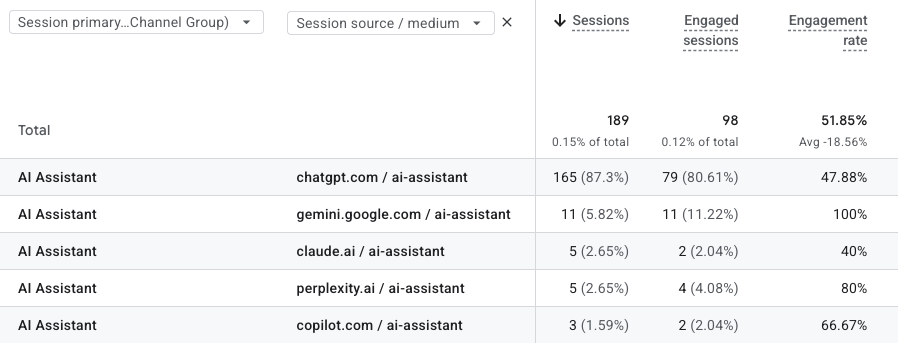
Until recently, tracking AI traffic included filtering traffic from the Referral Default Channel Group, and then adding a second metric to view the source and medium from each referral source. In May 2026, Google Analytics rolled out a new Default Channel Group for AI Assistant, which isolates AI platform traffic out of the box.
For marketers, that is a useful change. It gives us a clearer way to start following how AI tools are contributing to website discovery and, more importantly, what people do once they arrive.
But there are a few important limitations to understand before treating that new AI Assistant traffic data as the full story.
What Changed in Google Analytics 4 (GA4)?
When GA4 recognizes a referring source as an AI assistant, it can now automatically classify that traffic using:
- Channel: AI Assistant
- Medium:ai-assistant
- Campaign:(ai-assistant)
No special setup is required to activate the default classification. If qualifying traffic reaches your website, it can appear in GA4 alongside familiar channels such as Organic Search, Direct, Referral, Paid Search and Organic Social.
Google currently describes the channel as traffic from sources such as ChatGPT, Gemini, DeepSeek, Copilot, Claude, and Perplexity.
This gives marketers a much cleaner starting point for answering questions like:
- Are people actually clicking through to our website from AI tools?
- Which pages are they landing on?
- How engaged are those visitors?
- Are they completing key actions or converting?
- Is AI referral traffic growing over time?
Tracking AI Traffic: Why We’re Paying Attention
At cHaus, we have already started updating the monthly reports we deliver to clients to highlight AI Assistant traffic and explain what the data represents. It is a channel many of our clients are interested in following, particularly in B2B spaces.
It makes sense, as more people are using AI assistants over traditional search engines. This impacts the research process of comparing solutions, understanding unfamiliar topics, identifying vendors and narrowing down options before ever visiting a company website.
For many businesses, AI Assistant traffic remains a small share of overall website acquisition. Right now, the value is less about hitting a particular benchmark and more about establishing a baseline. We want to know where the traffic is coming from, which content attracts it and whether those visitors behave differently once they reach the site. Those patterns will become much more useful as we collect more data.
What the New AI Assistant Channel Does Not Tell You
Seeing AI Assistant traffic in GA4 does not mean you now have a complete picture of your visibility inside AI search and answer platforms.
GA4 can measure a website visit when someone clicks a link from a recognized AI assistant and the necessary referral information is available. It cannot measure every interaction that happened before that click.
For example, GA4 cannot tell you:
- How many times your company appeared in an AI-generated answer
- How often your content was cited without receiving a click
- How many people learned about your business through AI and later visited your site directly
- Your overall share of visibility across AI platforms
- What AI is actually saying about you.
So, while AI Assistant is an important new acquisition metric, it should not be mistaken for a complete measure of AI visibility.
Google AI Overviews and AI Mode Are Not Included
Another important catch for anyone working in SEO is that traffic from Google AI Overviews and Google AI Mode is not classified under AI Assistant. Google includes clicks from those experiences within Organic Search.
That means some AI-influenced website traffic will appear under AI Assistant, while traffic generated by Google’s own AI search experiences will continue to sit inside Organic Search.
For marketers, that makes the bigger picture more complicated, since a growing share of search discovery may now involve AI, but GA4 will not neatly place all of that behaviour into a single channel.
So, What Should Marketers Do With AI Assistant Data?
Start digging into what this traffic does on your site. Rather than focusing only on the number of sessions from AI assistants, consider the context around those visits.
Which landing pages are appearing? Are educational resources driving more AI referrals than product or service pages? Do these visitors stay engaged? Are they generating leads, downloads, form submissions or other meaningful actions?
It is also worth remembering that AI referral traffic is only one piece of a much larger shift in how people discover information online.
Search is becoming more fragmented. A potential customer might move between Google, an AI assistant, social media, industry content and your own website before making a decision.
The new AI Assistant channel in GA4 will not show us the entire user journey, but it does give us another useful piece of it.
Want help making sense of what AI traffic means for your website and reporting? We’re happy to help you dig into the data. Reach out to cHaus today.